 Written by Jane Aubrey
Five-year melanoma data and early breakthroughs in pancreatic and brain cancers signal that individualized mRNA vaccines are maturing from proof of concept into a new pillar of oncology.
For most of its modern history, oncology has operated on a fundamental asymmetry: cancer is a disease of individual mutations, yet treatments have been designed for populations. Chemotherapy, radiation, and even many targeted therapies are deployed as blunt instruments against a biological adversary that is, by its very nature, unique to each patient. The emergence of personalized mRNA cancer vaccines is the most direct challenge yet to that paradigm—and in June 2026, the evidence for their transformative potential reached a new level of maturity.
At the 2026 American Society of Clinical Oncology Annual Meeting in Chicago, Moderna and Merck presented five-year follow-up data for intismeran autogene (mRNA-4157), their investigational individualized neoantigen therapy, in combination with Merck’s checkpoint inhibitor Keytruda. Among patients with high-risk Stage III/IV melanoma who had undergone complete surgical resection, the combination reduced the risk of recurrence or death by 49 percent and the risk of distant metastasis or death by 59 percent compared to Keytruda alone. Crucially, the benefit has not eroded with time. At three years the recurrence-free survival advantage was essentially identical, suggesting that the immune memory trained by the vaccine is durable rather than transient.
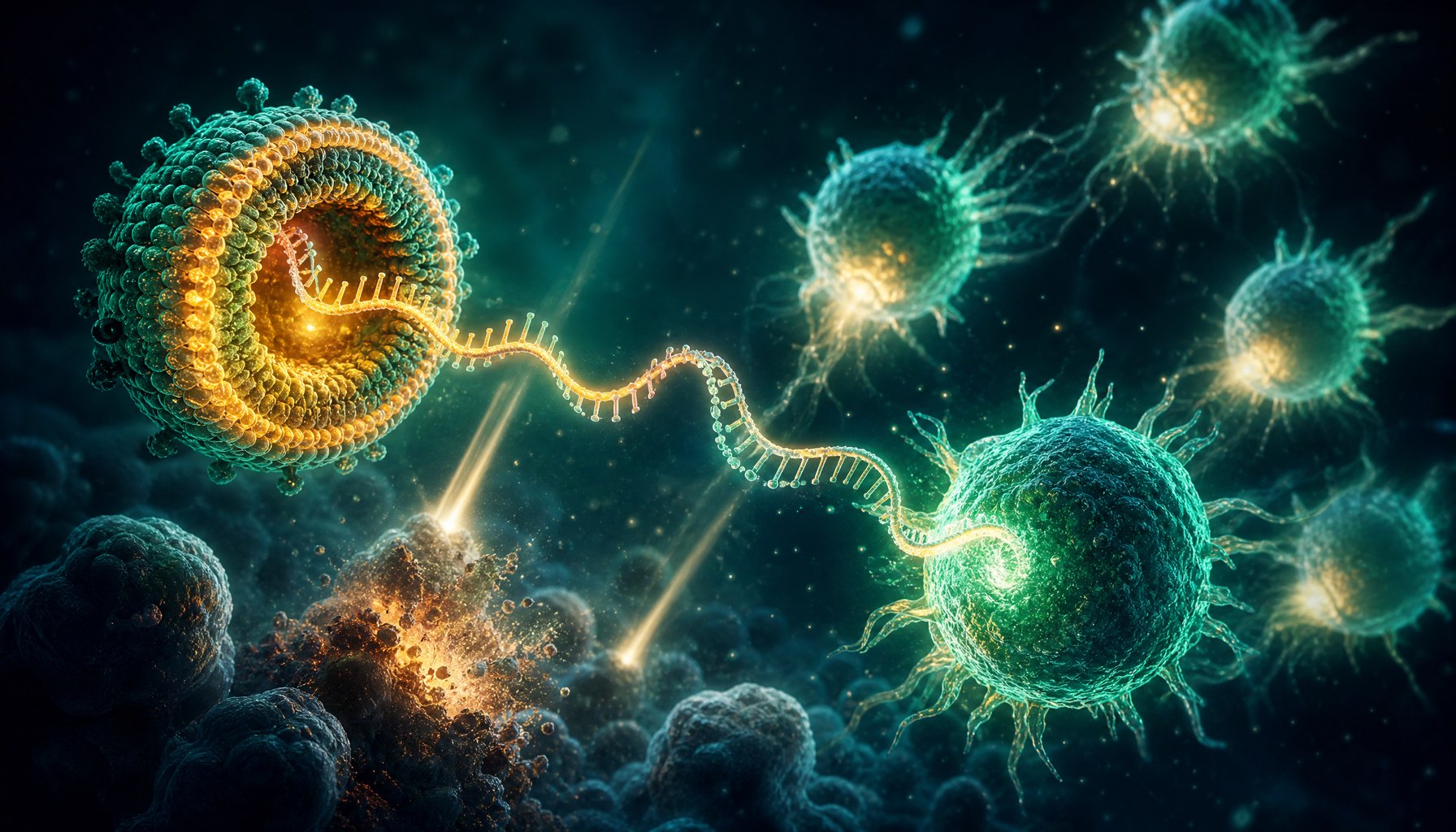
The mechanism is as elegant as it is ambitious. Each dose of intismeran autogene is manufactured specifically for the individual patient: a biopsy of the resected tumor is sequenced, an algorithm identifies up to 34 neoantigens—mutant proteins present on the cancer cells but absent from healthy tissue—and a synthetic mRNA encoding those neoantigens is produced and administered. The mRNA instructs the patient’s own cells to display these tumor-specific targets, training T-cells to recognize and destroy any residual or recurrent cancer bearing the same signature. Long-term immunological data presented at ASCO showed that patients receiving the combination had approximately twice the number of novel expanded T-cell clonotypes compared to those receiving Keytruda alone, and that these new clones were directly linked to intismeran-encoded neoantigens—confirming that the vaccine is doing precisely what it was designed to do.
The implications extend well beyond melanoma. As Reuters reported from ASCO, more than 130 studies at the meeting addressed mRNA-based cancer approaches. Moderna and Merck now have nine Phase 2 and Phase 3 trials underway across lung, kidney, bladder, and pancreatic cancers. In pancreatic cancer—long considered immunologically inert—a Phase 1 trial led by Dr. Vinod Balachandran at Memorial Sloan Kettering found that seven of eight patients whose immune systems responded to a BioNTech-manufactured mRNA vaccine were still alive up to six years after treatment, an outcome that would have been considered implausible a decade ago. A 260-patient global Phase 2 trial is now enrolling to confirm those results.
Delivery technology is advancing in parallel. Researchers at Mount Sinai have developed engineered lipid nanoparticles—the fat-bubble vehicles that ferry mRNA into cells—that can be tuned to target specific tissues and modulate the intensity of the immune response. At the University of Florida, Dr. Elias Sayour is testing a glioblastoma vaccine that uses clusters of nanoparticles rather than a single particle, aiming to rapidly mobilize the immune system against one of the most lethal and treatment-resistant brain cancers known, which carries a five-year survival rate below seven percent.
The field is not without headwinds. U.S. federal funding for mRNA vaccine research has been disrupted by the current political environment, with $500 million in cuts announced by the Department of Health and Human Services. The National Cancer Institute has partially offset this through a $200 million public-private partnership focused specifically on cancer vaccines. Scientists warn that artificially separating mRNA’s cancer applications from its infectious-disease applications risks slowing innovation across both domains.
What the five-year melanoma data make undeniable, however, is that the technology works—and that its effects endure. The personalized mRNA vaccine is no longer a hypothesis. It is a clinical instrument, and the question now is how broadly and how quickly it can be deployed.