 Written by Marcus Chen
A 10,000-fold acceleration in molecular simulation, a hidden cancer-protein pocket missed by leading AI tools, and the first human trials of AlphaFold-designed drugs mark a watershed moment for computational biotechnology.
The drug discovery pipeline has long been defined by attrition. A candidate molecule typically spends a decade traversing the distance from a laboratory hypothesis to a patient’s bedside, and fewer than one in ten compounds that enter clinical trials ever reach approval. Artificial intelligence has promised to compress this timeline for years. In the summer of 2026, three converging developments suggest that promise is finally materializing—while simultaneously revealing the boundaries that still remain.
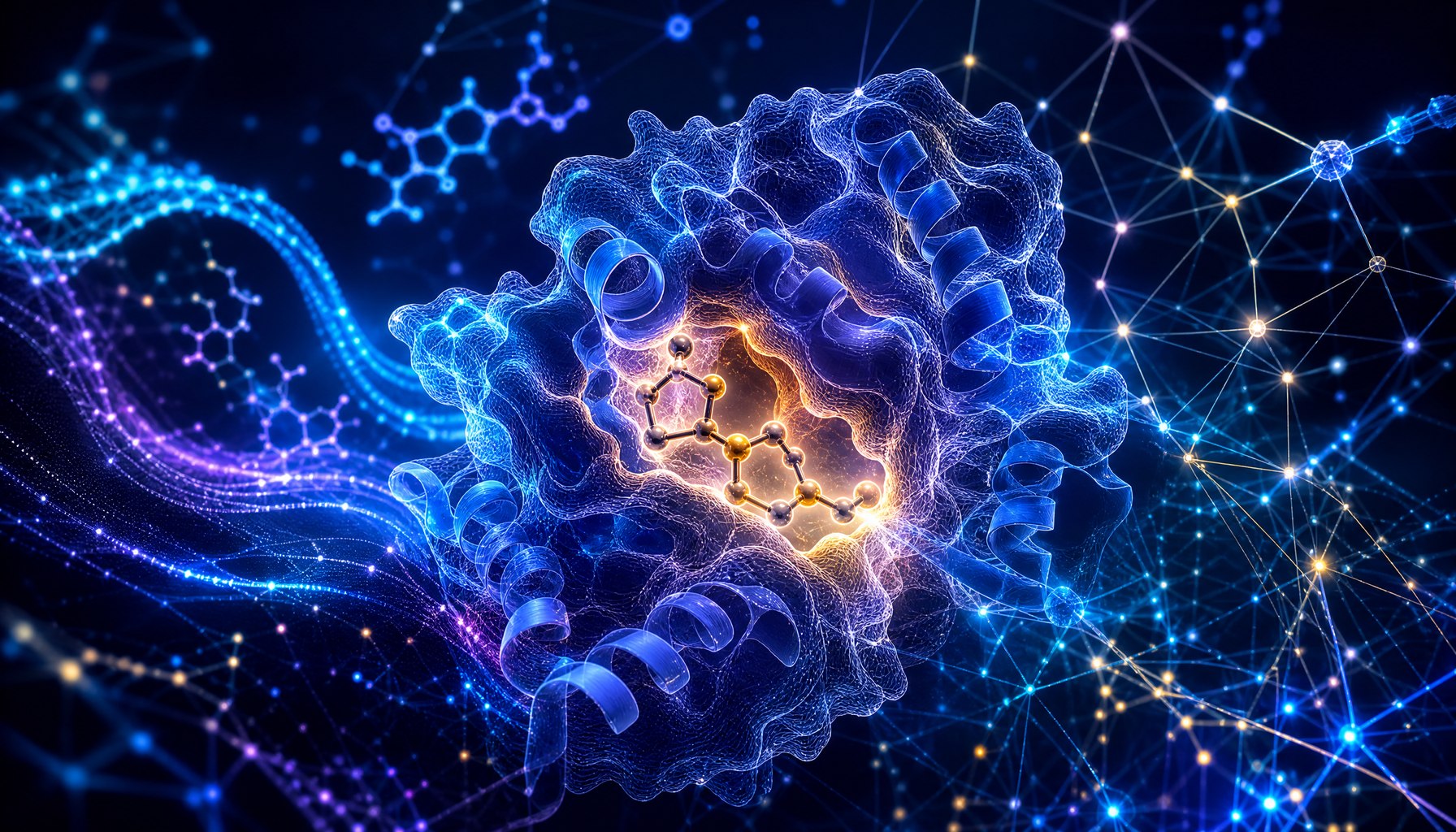
The most striking computational advance comes from a collaboration between Chalmers University of Technology and the University of Gothenburg in Sweden. Researchers there have published a new AI model in Science Advances that is more than 10,000 times faster than conventional molecular dynamics simulations. Traditional molecular dynamics works by calculating the forces between every atom in a molecule, advancing the system one femtosecond at a time—a computationally brutal process requiring billions of steps to capture the timescales relevant to drug binding. The new model, called TITO (Transferable Implicit Transfer Operators), learns the underlying statistical rules governing molecular motion and can leap directly to configurations that would otherwise require nanoseconds of simulation time to reach. Crucially, TITO generalizes: it applies its learned physics to molecules it has never encountered during training, making it a broadly applicable screening tool rather than a narrow, system-specific accelerator.
The implications for early-stage drug development are significant. A large proportion of the cost and time in pharmaceutical R&D is concentrated in the initial screening phase, where thousands of candidate molecules must be evaluated for their binding behavior. An AI model that can faithfully simulate molecular dynamics at a fraction of the computational cost could allow researchers to evaluate far larger chemical libraries with far greater mechanistic insight.
Yet a parallel study published in the Journal of the American Chemical Society by researchers at Mount Sinai’s Icahn School of Medicine provides a necessary counterpoint. The team used AlphaFold2, AlphaFold3, and Boltz-2 to study PKMYT1, a kinase implicated in cancer cell division. Using a combination of AI-predicted structures and X-ray crystallography, they discovered a previously unknown allosteric binding pocket—a site that all current state-of-the-art AI tools had missed entirely. The hidden pocket was only revealed through experimental validation, and the researchers found that even a minor chemical modification to a candidate molecule could cause it to switch from binding the novel site to a conventional one. The protein, it turns out, is far more conformationally dynamic than any static AI prediction captured. The finding is both a triumph and a cautionary note: AI accelerates exploration, but experimental biology remains the indispensable arbiter of molecular truth.
Against this backdrop of rapid capability and acknowledged limitation, the most consequential milestone may be the one unfolding in the clinic. Isomorphic Labs, the drug-discovery spin-off from Google DeepMind, is preparing to dose its first patients in human trials of oncology candidates designed using AlphaFold. The company’s proprietary model—described by outside scientists in Nature as representing the scale of an “AlphaFold 4″—goes beyond structure prediction to model how candidate molecules interact dynamically with their protein targets. Backed by $600 million in financing and partnerships with Novartis, Eli Lilly, and Johnson & Johnson, Isomorphic represents the most advanced attempt yet to translate AI-native drug design into clinical reality.
Together, these three developments define the current state of AI in biotechnology: simulation is accelerating by orders of magnitude, structural prediction is uncovering biology that was previously invisible, and the first generation of fully AI-designed therapeutics is crossing into human medicine. The question is no longer whether artificial intelligence will transform drug discovery. It is how quickly the field can build the experimental infrastructure to keep pace with what the algorithms are now capable of imagining.